Hey there!
This portfolio and its contents are currently not designed to be experienced on smaller screens.
For the best viewing experience, I recommend accessing the portfolio via the PDF version here.
Jio 5G Smartphones
Jio 5G Smartphones was a business strategy design project aimed at envisioning the potential future of 5G handheld devices at Jio. The Devices Design Team worked on conceptualizing three smartphone concepts.

Project Overview
Initial Context
Jio had previously launched 4G smartphones in the market in 2019, targeting the Indian demographic aiming to purchase entry-level smartphones. The project was revamped to continue the same initiative into 5G smartphones under the Jio brand.
The project was a strategic business proposition that would be reviewed by stakeholders for further development. The work involved creating sample spec sheets, target group definition and research, brainstorming on various directions, and finally selecting three ideas to be visualized for presentation. The broader aim was to pitch a distinct line-up of products, the design language of which could be adapted across Jio products.

The project began with identifying the necessities for creating a successful range of smartphone concepts that could potentially be launched in the Indian market by Reliance. The essential feature requirements and some of the defined specs are condensed and shown below.
6.1”
Screen Size
120Hz
Refresh rate
4500 mAh
Battery
All-in-One Powerhouse

Scalable Design
Ensuring that each of the concepts created scales to multiple dynamic form factors and price ranges.
24 MP Front Camera
with advanced facial recognition.
Market Differentiator
Creating designs that ensure that the concepts forge a unique identity amidst the competition.

Dual 48 MP Cameras
with room for more.

Latest-Gen Processor
Powered by Snapdragon chipsets, high efficiency and performance cores with in-built advanced AI and ML capabilities.
Snapdragon visuals used for reference only.
CPU
GPU
Memory
With the basic functionalities fixed upon, the project aimed to conceive concepts that could be displayed as standalone flagship smartphones, and could also be extrapolated both upwards and downwards to create further designs at different price brackets in further phases of the project
Market Study


Strategy Graph - Perceived Market Value vs Market Positioning of Brand
What do people look for when buying a phone?
What can the ID and UX team do?
Positioning
Focused
Varied
Redmi, Vivo, Oppo, Realme
Samsung
Huawei
Google, Apple
Nothing
Oneplus, 2016
Oneplus, 2022
LG
Moto
Cheap, low quality
Premium, high quality
Perceived value
A general look into the thought process while buying a phone. People look primarily for
Cost of the phone, and a look at the budget in hand
Features and tech specs available for the said cost
Camera quality, speed and smoothness of system, storage space
Brand value
Aesthetics and build quality
Average Mi phone review on Amazon
Brand Value, Aesthetics and Build Quality
Creating a unique visual identity for the externals of the phone, maybe a definitive design that could be followed and updated throughout generations
Not following the existing camera bump designs and phone ID seen generally in the present day market
UI could be integrated into the software around features such as the notch
ID and aesthetics won’t come into the picture until the phone itself provides something new and unique to the user.
Technical know how
User Base
Level of Income
Device cost
Device quality - features and specs


Form analysis
Soft forms, transparent, detailed design - all project quality


Soft forms
Feels like the object is Carved out of one composite whole
Transparent
Providing Transparency in material, structure & components
God is in the details
Every single button, every single feel of the components & how they work is detailed out.

Device-specific Form-factor Analysis
Specs and features
Trends
Insights
Premium features will be affordable.
More and more phones providing top level features but phones tend to not be optimised
Second screen will be aspirational.
Having top specs does not make a phone good, all the components need to work in sync with each other to provide a smooth experience. This cannot be achieved at lower costs, hence the reason why cheaper phones with good components still work slow.


CMF analysis
Back panels and textures
Trends
Insights
High-end premium phones stick with simple with true materials and simple colors. Materials / finishes such as glass and real metals beyond steel like copper, titanium will bring more strength and worldliness.
Trickle down theories will bring ceramic coating to mass phones.
Back panel designs and textures are becoming more of a trend these days due to the easy availability of cheap materials to create them on - mostly plastic or acrylic. Hence the High Gloss finish and sandblasted in entry segments.
Although some designs are interesting and make the phone appealing to a certain target group, not all users look at designs the same way. Some even go too extreme and look tacky.
Metallic housings reflects more subtle and premium range.


Urbanity with Real and genuine materials.
Other trends
Is Luminance the new chrome?
Trends
Lightened logos, edges, and functions are displayed with simple LED shapes.
“Nothing” triggered luminent explorations and patents from legends indicates the return of flaunting exciting illuminated surfaces.
Insired by the cars industry - fancy light effects are defining the new “chrome”.


KEY FINDINGS
After varying levels of demographic based research, the various CMF directions were converged into three categories catering to three main segments of users in India. These three segments were then categorized into three personas, corresponding to different geographies, mental models, usage patterns, and varying income and device usage levels across rural and urban India.
User Personas
Young & New
Age Group - 18-30 year olds
Income - Relatively new earners
Region - Metros & Cosmos
Fusionist
Age Group - 35-45 year olds
Income - Established earners
Region - Metros


Rooted
Age Group - 45+ year olds
Income - Retired or Dependent
Region - Across the board


CMF Styles


Young & New
Energetic | Vibrant


2023 Trend Forecasted Colours
Finishes


Contemporary | Stylish
Fusionist


2023 Trend Forecasted Colours
Finishes


Rooted
Traditional | Classy


2023 Trend Forecasted Colours
Finishes


The three personas and the respective CMF styles heavily influenced the form, and the look and feel of every idea created. These personas and styles led to the identification of three potential concept opportunities from within the array of options ideated upon.
Forging an Identity
The ideation phase began with identifying the three main differentiators for any smartphone that would enter the market at that point in time - the design of the back panel, the design of the camera island, and the shape and form of the device itself.


CONCEPT VALIDATION
All concepts created focussed on iterating within the given constraints of form, function and specs, while trying to ensure that scalability remains the most important aspect to be implemented across the board. Some sample ideas, initial concept drawings and renders are shown below.


BRAND SIMULATION
The concepts would be proposed as a part of a separate entity, unlinked to the Jio or Reliance brand. The aim was to ensure that the proposition remains memorable and identifiable outside of the parent identities. This would help in creating a global brand that would represent growth and innovation, thereby differentiating it from competition. A sample branding scheme was created to be used in representations.
The Logotype comprises of the brand JioPhone paired along with the name of the concept, to be used next to the logomark.
JioType Var
Pantone Black C
DM Serif Display
Color of the concept
JioPhone
JioPhone
JioPhone
JioPhone
Concept
ConceptA
ConceptB
ConceptC

For representation purposes, a modified globe was used as the Logomark, embodying a larger-than-life presence and potential scope for impact.
JioPhone
Concept01





FINAL CONCEPTS


Three concepts were selected from the variety of options and iterations. These three were differentiated (from left to right) on the basis of uniqueness in - back panel design, camera island design, and form of the device. - and were respectively based on the personas - Young & New, Fusionist and Rooted.
JioPhone
Segment
Segment splits the back panel into multiple parts, and implements a visually thicker recycled aluminium frame as the casing. This allows the device to display visual elements on the back, which is usually left plain. One of the segments houses the cameras, and the others can be used for visual branding, textures and modules.


01


Segment was designed as the proposition catering to the Young & New section of the target audience. To ensure that the styling remains in sync with the user group, a variety of colors and finishes were explored for the same. The black, pearl and sky blue options were selected to be the base colors.

JioPhone
Stealth
Stealth is envisioned to be the flagship killer variant among the JioPhone smartphone line-up. With a distinctive extended camera island design on the back, and the metal unibody casing, the device stands out as a unique offering aiming at providing both luxury and premium utility.


02

The Stealth concept was detailed out as the frontrunner in the line-up. It was created to have the latest Android OS running, with best in the industry features. The premium in-hand feel, thanks to the choice of materials and color & finishes, will go hand-in-hand with the high-level processing capability of the device.
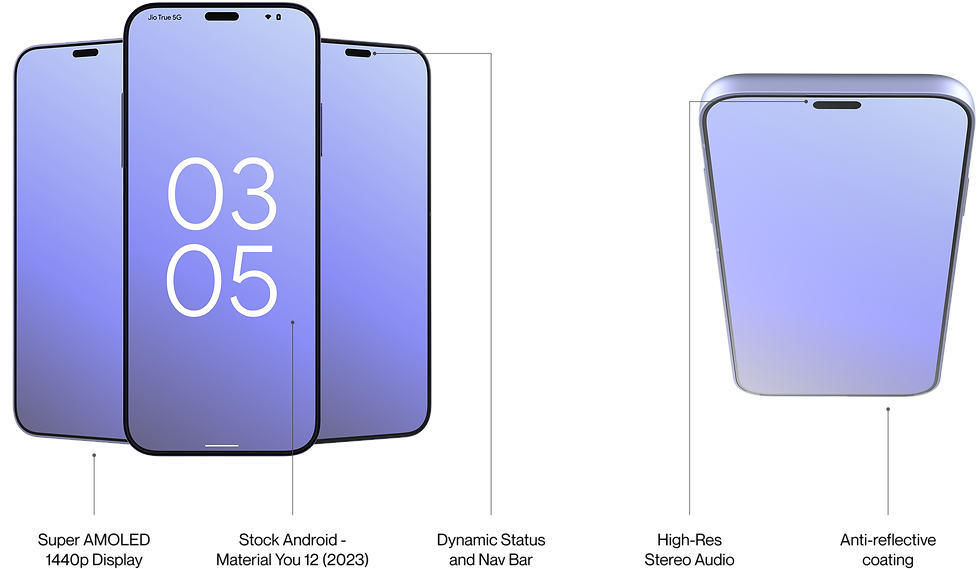


JioPhone
Dune
Dune represents the culmination of all the unique ideas created for the JioPhone. Inspired by the sand dunes of the Thar desert, the form derives from the smooth curves - the peaks and troughs - to structure the phone as a single aluminium unibody, without any components or separations breaking the form.


The back panel is made from polished acrylic covered with 3D formed Corning Glass.
The raised top section allows for multiple camera modules and sensors to be placed in the same array without disrupting the form.
The recycled aluminium frame enhances the form by differentiating the peak from the trough.
03


Dune was designed to break the standard format for smartphone design and manufacturing. By curving the back glass and the frame, the device is designed to fit snugly into the palms of the user. The semi-coarse metal textures and earthen colors are selected to emulate and evoke the raw stimulation of the desert sandstorms.


Desert Gold
Moonlight


Packaging Design
The project also involved creating initial drafts of potential packaging design options for the smartphone concepts. The goal was to design minimal packaging ideas that would enhance the premium aesthetic of the devices, and serve as a baseline for further packaging explorations.


